A real‑time blueprint of how a modern, scalable, AI‑powered platform is conceived, architected, and built — from first principles to global reach.
© 2026 Francis Cobbinah. All rights reserved.
This publication, including all text, concepts, structure, design, and original ideas, is the intellectual property of the author. No part of this work may be reproduced, distributed, or transmitted in any form or by any means, including photocopying, recording, or other electronic or mechanical methods, without the prior written permission of the author, except in the case of brief quotations used in reviews, academic analysis, or permitted fair use.
Unauthorized use, copying, adaptation, or distribution of this material is strictly prohibited and may result in legal action. This work is protected under international copyright law.
For permission requests, licensing enquiries, or professional contact, please reach out using the details below:
Email: francis@percentile.one
Mobile: 07432367704
Thank you for respecting the creative and intellectual work that has gone into building Percentile.One.
This will be regenerated to match the full section and chapter structure you’ve defined.
This chapter will explore the execution gap — again, we can fill this out in full prose next.
This chapter will explore why world‑class platforms matter — we’ll replace this placeholder with the full prose you’ve chosen (cinematic, hybrid, or both).
This chapter will explore the Be > Do > Have philosophy — we’ll replace this placeholder with the full hybrid prose next.
This chapter will explore what it truly takes to build a platform that can scale from zero users to one million — we’ll replace this placeholder with the full hybrid prose next.
This chapter explores how world‑class platform ideas are discovered — not invented. We’ll replace this placeholder with the full hybrid prose next.
This chapter explores how modern platforms move beyond vague wish‑lists and turn real‑world needs into precise, testable requirements.
This chapter explains how to use domain events to discover, define, and enforce bounded contexts — and why events are the language your platform needs to scale.
This chapter gives practical patterns, prompts, and governance for using AI to extract real requirements from messy human data.
This chapter shows the practical steps to convert requirements into architecture: slices, contracts, events, and minimal viable systems.
This chapter explores how Domain‑Driven Design turns messy, real‑world problems into clean, structured software models using ubiquitous language, bounded contexts, aggregates, and domain events—forming the backbone of P1’s architecture.
This chapter explains how Vertical Slice Architecture replaces layered systems with behaviour‑first design — building software one complete, testable, end‑to‑end flow at a time.
This chapter explains how to design microservices that are domain‑aligned, event‑driven, and operationally mature — enabling independent evolution without chaos.
This chapter explores how Minimal APIs provide the cleanest, fastest, and most expressive interface layer for modern architectures — especially microservices and vertical slices.
This chapter explores the principles that keep systems reliable and predictable under extreme load — from boundaries and events to idempotency, observability, and graceful degradation.
This chapter walks through concrete examples of how P1’s architecture works in practice — from slices and events to microservices and agents.
This chapter explains how Async/Await keeps P1 responsive under load, turning waiting time into productive time through non‑blocking operations.
This chapter explores how P1 uses parallelism and multithreading to increase throughput, accelerate computation, and scale agent workloads.
This chapter explores the techniques P1 uses to reduce allocations, optimise memory, and maximise throughput using modern C# features.
This chapter demonstrates how P1 applies performance engineering in real scenarios — from goal creation to agent analysis to event stream processing.
This chapter explores how Azure Functions enable elastic, event-driven, cloud-native compute — forming the backbone of P1’s background processing, automation, and intelligent workflows.
This chapter explores Azure Service Bus — the enterprise-grade messaging system that powers reliable communication, event-driven workflows, and microservice decoupling across P1’s cloud-native architecture.
This chapter explores how modern platforms use events to communicate, scale, and react in real time — forming the backbone of P1’s intelligent, reactive architecture.
This chapter explores how logs, metrics, and traces form the nervous system of a cloud-native platform — enabling deep visibility, rapid debugging, and intelligent scaling across P1.
This chapter walks through concrete, end-to-end cloud-native flows inside Percentile.One — showing how Functions, Service Bus, events, and observability come together to form a production-grade platform.
This chapter explores the shift from traditional software to agentic systems — autonomous, context‑aware components that reason, plan, and take action inside modern platforms like P1.
This chapter explores how to design workflows that combine events, context, reasoning, and action — the foundation of agentic behaviour inside modern platforms like P1.
This chapter shows how agentic behaviour is implemented inside Percentile.One — turning events, context, and reasoning into real, production‑ready features that think and act on behalf of the user.
This chapter explores how modern platforms use AI, telemetry, and behavioural signals to personalise experiences in real time — creating systems that evolve with every interaction.
This chapter explores the next decade of platform engineering — from agentic systems to autonomous workflows, adaptive architectures, and the rise of intelligent platforms like P1.
This chapter introduces the frontend stack behind Percentile.One — React for component-driven architecture and Tailwind for rapid, expressive styling that keeps design consistent and scalable.
This chapter explores how to design a component architecture that is scalable, predictable, and aligned with the platform’s domain-driven structure — the foundation of P1’s frontend.
This chapter explores how wireframing and prototyping have evolved in the age of AI — where interfaces are no longer static, but adaptive, intelligent, and shaped by real-time behaviour.
This chapter explores the UX patterns and cinematic principles that make intelligent platforms feel fluid, intuitive, and emotionally engaging — transforming user interactions into meaningful experiences.
This chapter introduces the foundations of Agentic UI — interfaces that adapt to user behaviour, context, and sentiment, enabling intelligent, real-time interactions that feel supportive and intuitive.
This chapter showcases real examples of Agentic UI inside P1 — from the Explorer to adaptive insights, real-time components, and intelligent flows that evolve with the user.
This chapter explores why AI is not just another tool, but a fundamental shift in how software is imagined, built, and delivered — and why it changes the physics of engineering itself.
This chapter breaks down the core principles behind generative AI — how models learn, how they generate, and why they’ve become the new foundation for modern engineering, creativity, and intelligent systems.
This chapter explores how AI transforms the development lifecycle — from writing code and generating tests to reasoning about architecture, debugging, and accelerating delivery. It reframes AI as a collaborative engineering partner rather than a passive tool.
This chapter introduces the core principles behind agentic systems — software that doesn’t wait for instructions but takes initiative, orchestrates workflows, and collaborates with users to achieve outcomes. It explores the patterns, behaviours, and design principles that make agentic intelligence possible.
This chapter explores how user interfaces evolve when powered by agentic intelligence — shifting from static screens to adaptive, context‑aware experiences that anticipate needs, guide users, and participate in the workflow rather than simply displaying it.
This chapter showcases concrete examples of how AI and agentic patterns power real features inside Percentile.One — from requirement extraction and architecture generation to adaptive UIs, workflow orchestration, and intelligent developer assistance.
This chapter introduces the foundational concepts that underpin every world‑class digital platform — entities, relationships, schemas, and the separation of operational and analytical data.
SQL remains the backbone of analytical and operational data work. This chapter explores how to think in sets, design efficient queries, and use relational structures to unlock deep insight across your platform.
This chapter explores the world beyond relational databases — document stores, key–value stores, columnar systems, and distributed data patterns that keep modern platforms responsive at scale.
This chapter explores how platforms collect, transform, and deliver data reliably — turning raw events into structured insight through pipelines, orchestration, and modern ETL/ELT patterns.
This chapter turns theory into practice by walking through real data structures, events, and queries from inside Percentile.One — showing how the platform’s data layer actually works in production.
This chapter explores how to architect a modern mobile application using .NET MAUI — aligning mobile design with the platform’s domain model, backend services, and long-term evolution.
This chapter explores how to design intuitive, elegant mobile experiences within the constraints of small screens, limited attention, and real-world usage patterns.
This chapter explores how to design mobile experiences that remain reliable, responsive, and trustworthy even when connectivity is weak, intermittent, or completely unavailable.
This chapter explores how modern mobile apps use on‑device intelligence and agentic patterns to create proactive, personalised, and context‑aware experiences — even without constant connectivity.
This chapter brings the mobile architecture to life with real examples from the Percentile.One mobile app — screens, view models, sync flows, and patterns that show how everything fits together in practice.
This chapter explores how real growth happens in motion — in the small pockets of time, the in‑between moments, and the rhythm of everyday life. Growth is not an event. It’s a lifestyle.
This chapter explores what it really means to design for the hand — not the desktop. It looks at ergonomics, thumb zones, reachability, posture, and the realities of one‑handed use, and how those constraints shape the structure of a truly mobile‑first interface.
This chapter explores how motion, transitions, rhythm, and micro‑animation create a cinematic identity for the mobile experience — making the app feel alive, expressive, and emotionally resonant.
This chapter explores the Mobile Explorer — the adaptive navigation layer of Percentile.One. It’s more than a menu. It’s a living, intelligent guide that helps users move through their journey with clarity, context, and confidence.
This chapter explores how AI transforms mobile workflows from manual, step‑by‑step tasks into intelligent, adaptive, and proactive experiences. The mobile app becomes a collaborator — anticipating needs, reducing friction, and amplifying the user’s ability to grow on the go.
This chapter explores the power of micro‑actions — tiny, intentional behaviours that take seconds but compound into extraordinary progress. Micro‑actions make growth possible anywhere, anytime, in the flow of real life.
This chapter explores how modern mobile apps use on‑device intelligence, local models, and resilient design to deliver a seamless experience even when offline. Growth shouldn’t pause just because the signal drops.
This chapter explores the future of mobile agents — intelligent, autonomous systems that anticipate needs, take action, and support growth in real time. Mobile agents will transform the phone from a tool into a true partner.
This cinematic front cover represents the engineering edition of Building a World‑Class Digital Platform. It features a deep blueprint aesthetic with glowing cyan circuitry and grid lines, symbolizing the architecture and intelligence behind modern digital platforms.
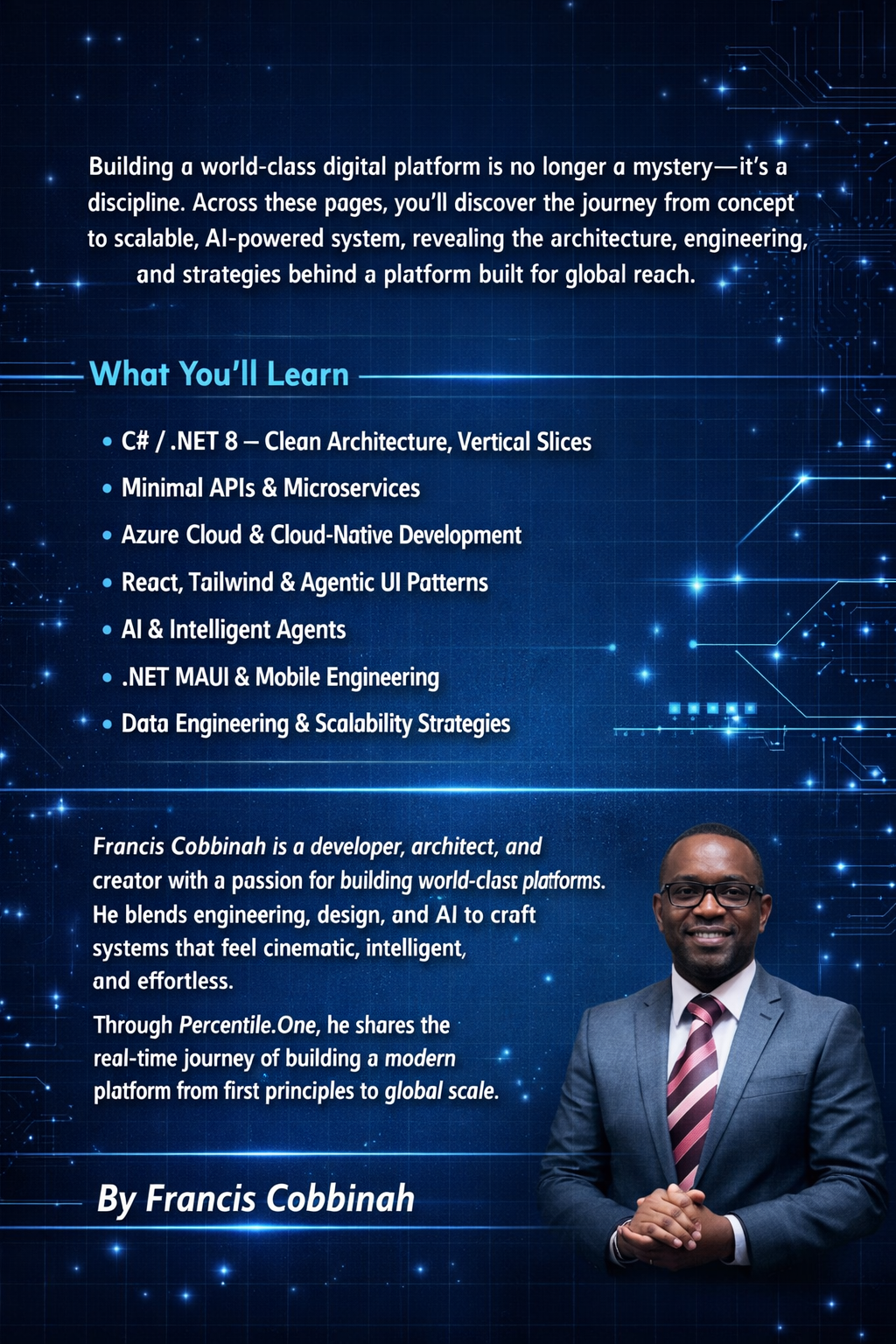
This is the cinematic back cover for Building a World‑Class Digital Platform, featuring the expanded description, developer learning outcomes, and author biography. It completes the book’s visual identity with the same blueprint‑driven, high‑tech aesthetic as the front cover.
Most C# developers eventually realise something uncomfortable: the AI ecosystem speaks Python.
Not because Python is “better,” but because it’s where the tooling, libraries, and research live.
In this appendix, you position Python as a side‑arm to your C# architecture — not a replacement.
Python gives you fast experimentation, access to AI libraries, and data workflows. C# gives you structure, performance, and production‑grade systems. Together, they form a hybrid stack.
Variables, lists, dictionaries, functions, imports, and running scripts — enough to read and adapt AI examples.
Use Python for model training, preprocessing, and experimentation; use .NET for APIs, orchestration, and production.
Testing used to be slow, manual, and brittle. AI changes that.
AI can read your code, infer intent, and propose test cases and edge conditions.
It can simulate workflows, generate API scenarios, and help you explore performance bottlenecks.
As your system evolves, AI can help refactor tests, update assertions, and keep coverage meaningful.
What does it take to build a platform capable of serving millions? What does it take to design systems that understand people, guide behaviour, and unlock human potential?
Building a World‑Class Digital Platform:
From Zero to 1M+ Subscribers
is the blueprint for founders, engineers, architects, and creators
who want to build something that lasts.
You’ll learn how to:
Percentile.One is more than an app — it is a Performance OS. This book takes you behind the scenes of its architecture, philosophy, and evolution.
This book is written for engineers, architects, founders, leaders, and anyone who wants to understand how world‑class platforms are built.